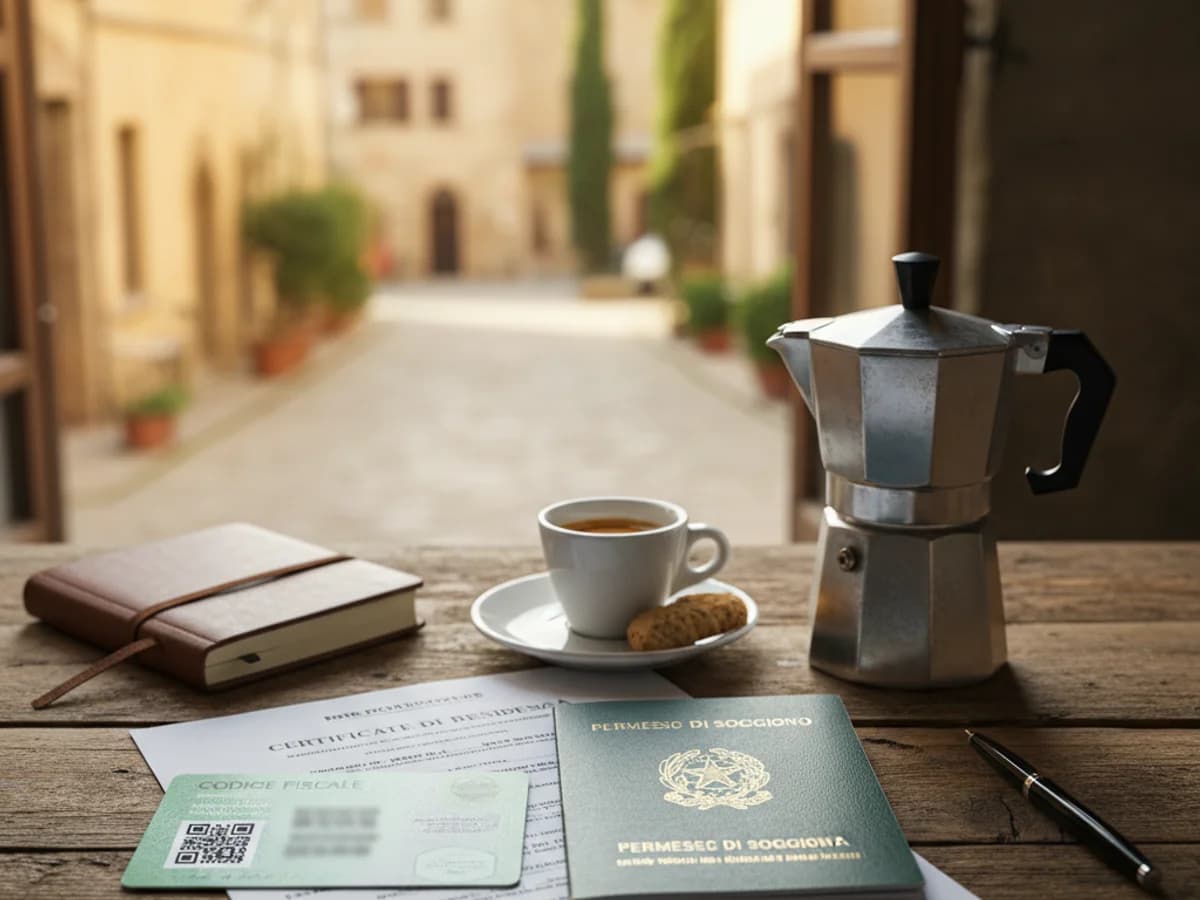

Navigating Italian Bureaucracy: What to Expect
Italian bureaucracy has a well-earned reputation for complexity, slow processing times, and occasional opacity. For foreign retirees, the first weeks and months in Italy involve a series of administrative procedures that are essential for establishing legal residence, accessing healthcare, opening bank accounts, and conducting everyday life.
The good news: while the process requires patience and organization, it is entirely manageable with proper preparation. Thousands of foreign retirees successfully navigate these procedures every year. This guide provides a chronological roadmap of every administrative step, from your first day in Italy to full integration into the Italian system.
📌 Key Takeaways
- The Codice Fiscale is your universal identification number — get it first
- Anagrafe (residence) registration is mandatory and unlocks access to all other services
- Permesso di Soggiorno (non-EU) must be applied for within 8 days of arrival
- An Italian bank account is essential for rent payments and utilities
- SSN enrollment provides access to free or low-cost healthcare
The essential principle: every procedure connects to others. Your Codice Fiscale is needed for your residence registration, which is needed for your Permesso di Soggiorno, which is needed for SSN enrollment, which is needed for your Tessera Sanitaria. Understanding this chain — and following it in the right order — prevents delays and frustration.
The Codice Fiscale: Your Italian Identity Number
What It Is
The Codice Fiscale is a 16-character alphanumeric code that serves as your Italian tax identification number and, in practice, your universal identifier for all administrative and commercial interactions in Italy. It is the Italian equivalent of a Social Security Number (US), National Insurance Number (UK), or Social Insurance Number (Canada).
The code is generated algorithmically from your surname, first name, date of birth, place of birth, and gender. For foreign nationals, the place of birth is coded using the country code (e.g., Z404 for the United States, Z114 for the United Kingdom).
Why You Need It
You need a Codice Fiscale for virtually everything in Italy:
- Signing a rental contract or property purchase deed
- Opening a bank account
- Registering your residence
- Enrolling in the SSN (healthcare)
- Setting up utility contracts (electricity, gas, water, internet)
- Filing tax returns
- Purchasing a car or motorcycle
- Obtaining a SIM card for a mobile phone
- Making purchases above certain thresholds
- Registering for online public services (SPID identity)
How to Obtain It
Option 1: At the Italian Consulate (Before Arrival)
You can request a Codice Fiscale at the Italian consulate in your country of residence before moving. Bring your passport; the process is usually same-day. This is highly recommended — having your Codice Fiscale before arriving allows you to sign rental contracts and open certain bank accounts immediately.
Option 2: At the Agenzia delle Entrate (After Arrival)
Visit any office of the Agenzia delle Entrate (Italian Revenue Agency) with:
- Your valid passport
- A completed Modello AA4/8 form (available at the office or downloadable from the Agenzia's website)
The Codice Fiscale is issued immediately, usually within 15-30 minutes. You will receive a paper certificate; the physical card (tessera) arrives by mail within 2-6 weeks.
Option 3: Online (Limited)
EU citizens with a CIE (Carta d'Identita Elettronica) or SPID can request a Codice Fiscale online through the Agenzia delle Entrate portal. This option is not available to most newly arriving retirees.
Tips
- The Codice Fiscale never changes, even if you change your name or address
- Keep multiple copies (paper and digital) — you will need to provide it frequently
- If you lose the card, request a duplicate at any Agenzia delle Entrate office
💡 Good to know
Get your Codice Fiscale before arrival at the Italian consulate in your country. This allows you to sign rental contracts and open bank accounts immediately, without waiting.
Residence Registration (Iscrizione Anagrafica)
What It Is
Registering your residence (dichiarazione di residenza) at the Anagrafe (civil registry) of your chosen municipality is a fundamental legal requirement. It establishes your official address in Italy and is a prerequisite for most other administrative procedures.
When to Register
- EU citizens: must register within 90 days of arrival if planning to stay longer than three months
- Non-EU citizens: should register as soon as possible after receiving their Permesso di Soggiorno (or simultaneously with the application)
How to Register
Visit the Ufficio Anagrafe of your municipality with:
- Valid passport or national ID
- Codice Fiscale
- Proof of accommodation: registered rental contract (contratto di locazione registrato) or property deed
- For EU citizens: proof of sufficient financial resources and health insurance (or SSN enrollment)
- For non-EU citizens: Permesso di Soggiorno or receipt of application (ricevuta)
- Completed Dichiarazione di Residenza form (usually provided at the office)
The office will accept your declaration and initiate a verification process. Within 45 days, a Vigile Urbano (municipal police officer) will visit your declared address to verify that you actually live there. If the visit confirms your presence, your registration is finalized.
What You Receive
Once registered, you can request:
- Certificato di residenza: a certificate proving your registered address. Needed for many subsequent procedures
- Stato di famiglia: a certificate listing all members of your household registered at that address
These certificates are available at the Anagrafe office, often through online municipal portals, or via the national ANPR (Anagrafe Nazionale della Popolazione Residente) system.
Change of Address
If you move within Italy, you must declare your new residence at the Anagrafe of the new municipality within 20 days. The old registration is automatically cancelled.
Permesso di Soggiorno: The Residence Permit
Who Needs It
All non-EU citizens staying in Italy for more than 90 days need a Permesso di Soggiorno (residence permit). EU/EEA citizens do not need a Permesso — their right to reside is established through Anagrafe registration alone.
Application Process
You must begin the application within eight business days of entering Italy on your visa. The process uses the Kit Postale system:
Step 1: Obtain the Kit
Go to any post office (Poste Italiane) displaying the "Sportello Amico" sign and request a Kit for the Permesso di Soggiorno. The kit is free and contains forms, instructions, and a return envelope.
Step 2: Complete the Forms
The kit includes two main modules:
- Modulo 1: personal data form — your name, date of birth, nationality, passport number, address in Italy, and Codice Fiscale
- Modulo 2: specific to your visa type. For the Elective Residence Visa, select the appropriate category (Residenza Elettiva)
Complete the forms carefully in block capitals. Errors or omissions can cause delays.
Step 3: Assemble Supporting Documents
Include copies of:
- All pages of your passport with stamps or visas
- Your visa page
- Codice Fiscale
- Proof of accommodation (registered rental contract or property deed)
- Proof of income (bank statements, pension statements)
- Health insurance policy or SSN enrollment receipt
- Four passport-size photographs (white background, biometric standard)
Step 4: Submit at the Post Office
Return to the Sportello Amico with your completed kit and documents. The postal worker will:
- Check that the forms are complete
- Issue a receipt (ricevuta) with a reference number and a date for your appointment at the Questura
- Collect the submission fee: approximately EUR 30 for the postal service plus a EUR 16 marca da bollo (revenue stamp), purchased at a tabaccheria
Step 5: Attend the Questura Appointment
On the scheduled date, go to the Questura (police headquarters) or Ufficio Immigrazione with:
- All original documents (passport, visa, insurance policy, proof of income, proof of accommodation)
- The ricevuta from the post office
- Your Codice Fiscale
At the Questura, they will:
- Verify your identity and documents
- Take your fingerprints (all ten fingers)
- Take your photograph
- Ask basic questions about your reason for being in Italy
You may receive the Permesso di Soggiorno at this appointment, or you may be given a date to collect it (typically 2-8 weeks later). Some Questure mail it to your registered address.
The Permesso di Soggiorno Card
The physical Permesso is a credit-card-sized electronic document containing:
- Your photograph
- Personal data
- Type and duration of the permit
- Biometric data (fingerprints) on the embedded chip
It serves as your official identification for all interactions requiring proof of legal residence.
Duration and Renewal
The initial Permesso linked to an Elective Residence Visa is typically valid for two years. Begin the renewal process approximately 60 days before expiration, using the same Kit Postale system. For more details on this visa type, see our guide on Italy's Elective Residence Visa.
For renewal, you must demonstrate continued eligibility: ongoing income, valid accommodation, and continuous residence in Italy.
The Ricevuta as Interim Documentation
While your Permesso application is being processed, the ricevuta (postal receipt) serves as temporary proof of your legal status. Combined with your passport and visa, it allows you to remain in Italy, access healthcare, and conduct most administrative procedures.
⚠️ Warning
Permesso di Soggiorno applications must be submitted within 8 days of your arrival in Italy. Do not miss this deadline, or you risk administrative complications and could be asked to leave the country.
Opening a Bank Account (Conto Corrente)
Why You Need an Italian Bank Account
An Italian bank account is practically essential for:
- Paying rent (Italian landlords expect bank transfers or direct debits)
- Paying utilities (most utility companies require an Italian IBAN for direct debit — RID/SDD)
- Receiving any Italian-source income
- Paying taxes
- Daily transactions (many Italian businesses, especially smaller ones, still prefer cash or Italian debit cards)
Required Documents
To open a conto corrente (current account), you need:
- Valid passport
- Codice Fiscale
- Proof of residence in Italy (certificato di residenza or registered rental contract)
- Permesso di Soggiorno (for non-EU citizens) or proof of Anagrafe registration (EU citizens)
- Proof of income or financial status (some banks request this)
Major Banks
The largest Italian retail banks include:
- Intesa Sanpaolo: Italy's largest bank, extensive branch network, some English-speaking staff in larger cities
- UniCredit: international presence, English-speaking services available
- Banca Mediolanum: known for personalized service through "family bankers"
- BNL (Banca Nazionale del Lavoro): part of the BNP Paribas group
- Banco BPM: strong in Northern Italy
Online and Digital Banks
Several digital banks operate in Italy with English-language interfaces:
- N26: German digital bank, fully operational in Italy, English interface, free basic account
- Revolut: excellent for multi-currency needs, free basic account
- Hype: Italian fintech, good for daily banking
- Fineco: Italian online bank with excellent investment services
Account Costs
Traditional Italian bank accounts often carry monthly fees (EUR 2-10/month) and per-transaction charges. Online banks are generally free or very low cost. Compare offers carefully — the Banca d'Italia's comparison tool (confrontaconticorrenti.it) can help.
The Imposta di Bollo
Italian bank accounts are subject to an annual stamp duty (imposta di bollo) of EUR 34.20 for individuals. Securities accounts (depositi titoli) are subject to 0.20% of the account value annually. These are automatically deducted by the bank.
| Bank Type | Monthly Fees | Customer Support | Online Access |
|---|---|---|---|
| Traditional Bank (Intesa, UniCredit) | EUR 2-10 | Branches + phone | Good |
| Online Bank (Fineco) | EUR 0-5 | Phone + chat | Excellent |
| Neobank (N26, Revolut) | Free-5 EUR | Chat + app | Excellent |
SPID: Italy's Digital Identity System
What It Is
SPID (Sistema Pubblico di Identita Digitale) is Italy's national digital identity system. It provides secure access to hundreds of online public services, including:
- Agenzia delle Entrate (tax filings, Codice Fiscale management)
- INPS (social security, pension information)
- SSN (healthcare appointments, medical records)
- Municipal services (certificates, payments)
- Utilities registration
How to Get SPID
To obtain SPID, you need:
- A valid Italian identity document (Carta d'Identita, Permesso di Soggiorno, or passport with Italian tax code)
- A Codice Fiscale
- An Italian mobile phone number
- An email address
SPID is issued by accredited Identity Providers (IdP). The most popular include:
- PosteID (Poste Italiane): free, obtainable at any post office with in-person identification
- Aruba: free basic level
- InfoCert: free basic level
- Namirial: paid (EUR 19.90) but can be completed entirely online via video call
The process involves creating an account with your chosen IdP, providing your documents, and completing identity verification (in person, via video call, or using CIE/CNS).
Why It Matters for Retirees
SPID dramatically simplifies interactions with Italian bureaucracy. Instead of visiting offices in person, you can handle many procedures online: requesting certificates, viewing your tax position, booking medical appointments, and accessing your health records. For more details on healthcare access, consult our comprehensive guide on Italy's healthcare system for retirees.
Driving in Italy
Using Your Foreign License
- EU/EEA licenses: valid indefinitely in Italy for residents. No conversion needed, but you must register your address change with the Motorizzazione Civile
- Non-EU licenses: valid for one year from establishing residence. After one year, you must convert to an Italian license or obtain a new one
Converting a Non-EU License
Italy has reciprocal license conversion agreements with certain countries (including the US states of several, but not all). Check with the Motorizzazione Civile whether your specific license is eligible for direct conversion.
If conversion is available:
- Visit the Motorizzazione Civile with your foreign license, passport, Codice Fiscale, Permesso di Soggiorno, medical certificate, and passport photos
- Pay the required fees (approximately EUR 80-120)
- Receive your Italian license
If conversion is not available, you must take the Italian driving test:
- Theory exam (esame di teoria): multiple-choice test covering Italian traffic laws. Available in Italian only (some provinces allow foreign language assistance). Studying with a local driving school (autoscuola) is recommended
- Practical exam (esame di guida): a driving test with an examiner
Italian Driving Culture
Italian driving, particularly in the south and in cities, can be significantly more aggressive and chaotic than what many foreigners are accustomed to. Key differences include:
- Roundabouts (rotonde) follow right-of-way rules that differ from some countries
- ZTL (Zona Traffico Limitato) — restricted traffic zones in many historic centers. Entering without authorization results in automatic fines via camera detection
- Speed cameras (autovelox) are widespread; fines are mailed to registered owners
- Parking rules are color-coded: white lines = free, blue lines = paid, yellow lines = reserved
Utilities Setup
Electricity
The main electricity providers include Enel Energia, Edison, Eni Plenitude, and A2A. To activate a contract, you need:
- Codice Fiscale
- Proof of residence or rental contract
- The POD code (punto di consegna) — an identifier for the electrical connection point, found on the meter or provided by the landlord
- Italian IBAN for direct debit
Gas
The process is similar to electricity. You need the PDR code (punto di riconsegna) for the gas meter. Major providers include Eni Plenitude, Edison, and Italgas (distribution) with various commercial suppliers.
Water
Water is managed by municipal or regional utilities. The landlord or property agent typically helps set up the account. You need your Codice Fiscale and proof of residence.
Internet and Mobile
Italy has good broadband coverage, with fiber (FTTH) available in many towns and cities. Main providers:
- TIM: largest network, widest fiber coverage
- Vodafone Italia: strong fiber and mobile offerings
- WindTre: competitive pricing
- Fastweb: strong in urban areas
- Iliad: mobile-first, very competitive pricing
For mobile, Iliad and ho. (by Vodafone) offer the best value at EUR 6-12/month for generous data plans. Activating a SIM requires your passport and Codice Fiscale.
The PEC (Posta Elettronica Certificata)
What It Is
PEC is Italy's certified email system — a legally binding form of electronic communication equivalent to registered mail (raccomandata). Communications sent via PEC have legal proof of delivery and reception.
Do You Need It?
While individuals are not legally required to have a PEC address, it is increasingly useful for:
- Communicating with public administrations
- Filing complaints or requests with legal standing
- Receiving official communications from the Agenzia delle Entrate
How to Get It
PEC addresses are available from authorized providers (Aruba, Legalmail, PostaCertificata) for approximately EUR 5-25/year.
Useful Contacts and Resources
Key Government Offices
- Agenzia delle Entrate (tax authority): agenziaentrate.gov.it
- INPS (social security): inps.it
- Questura (police/immigration): search for your local office at questure.poliziadistato.it
- ASL (local health authority): search by region through the Ministry of Health site
- Motorizzazione Civile (driving/vehicle authority): ilportaledellautomobilista.it
Essential Italian Phrases for Bureaucracy
- "Vorrei fissare un appuntamento" — I would like to make an appointment
- "Ho bisogno di un certificato di residenza" — I need a residence certificate
- "Dove devo andare per..." — Where do I need to go for...
- "Puo parlare piu lentamente, per favore?" — Can you speak more slowly, please?
- "Ho il mio Codice Fiscale" — I have my Codice Fiscale
- "Mi serve la marca da bollo" — I need a revenue stamp
- "Quanto tempo ci vuole?" — How long does it take?
A Practical Timeline: First 30 Days
| Day | Action |
|---|---|
| Day 1-2 | Obtain Codice Fiscale at Agenzia delle Entrate |
| Day 1-3 | Activate mobile phone SIM (for communications) |
| Day 3-5 | Register residence at Anagrafe |
| Day 3-8 | Apply for Permesso di Soggiorno via Kit Postale (non-EU) |
| Day 5-10 | Open Italian bank account |
| Day 7-14 | Enroll in SSN at local ASL; choose a GP |
| Day 7-14 | Set up utility contracts (electricity, gas, water, internet) |
| Day 14-21 | Obtain SPID digital identity |
| Day 14-30 | Meet with a commercialista to plan tax filings |
| Day 14-30 | Convert driving license (if applicable) or begin the process |
Tips for Surviving Italian Bureaucracy
Patience Is Non-Negotiable
Italian administrative processes operate at their own pace. Offices may close unexpectedly, staff may be on break, and forms may need to be resubmitted. Accept this as part of the cultural experience rather than a personal affront.
Always Bring Extra Documents
Bring more documentation than you think you need. If in doubt, bring the original and three copies. Italian offices frequently request documents that are not listed in the official requirements.
Go Early
Many Italian offices operate on a first-come, first-served basis without appointments. Arriving 15-30 minutes before opening significantly reduces your wait time.
Make Friends with the Tabaccaio
The tabaccheria (tobacco shop) is an unofficial hub of Italian bureaucracy. It sells marche da bollo (revenue stamps), bus tickets, phone credit, and sometimes even handles basic postal services and government payments.
Consider a Patronato
A patronato is a free advisory service, often run by labor unions (CGIL, CISL, UIL), that helps with administrative procedures including INPS registration, tax returns, and residency paperwork. They serve Italian and foreign residents alike and can be invaluable for navigating complex procedures.
Hire Professional Help
For your first year, investing in professional support saves time and stress:
- Commercialista (tax advisor): EUR 500-1,500/year for tax filings and compliance
- Avvocato (lawyer): for property transactions and complex legal matters
- Relocation consultant: some firms specialize in helping foreign retirees settle in Italy, handling all paperwork for a flat fee (EUR 1,000-3,000)
Conclusion
Italian administrative procedures are numerous and sometimes labyrinthine, but they follow a logical sequence. The Codice Fiscale unlocks everything; residence registration establishes your legal presence; the Permesso di Soggiorno (for non-EU citizens) confirms your right to stay; and SSN enrollment, bank accounts, and utility contracts build the infrastructure of daily life. By following the timeline above, assembling the right documents in advance, and maintaining patience and good humor, you will navigate Italian bureaucracy successfully and be fully settled within your first month. Once complete, these procedures rarely need repeating, leaving you free to enjoy the extraordinary life that Italy offers.
Frequently Asked Questions
How long does it take to get a Codice Fiscale?
If you apply at the Agenzia delle Entrate in Italy, the Codice Fiscale is issued immediately (15-30 minutes). The physical card arrives by mail in 2-6 weeks. It's recommended to get yours from the Italian consulate before departure, which speeds up your settlement.
Can I stay in Italy with the ricevuta (receipt) from the Permesso di Soggiorno while it's being processed?
Yes, the ricevuta serves as temporary proof of legal status. Combined with your passport and visa, it allows you to remain legally in Italy, access healthcare services, and conduct most administrative procedures until you receive your final Permesso.
Do I need to have an Italian bank account to live in Italy?
Technically no, but it's very strongly recommended. Landlords expect bank transfers or direct debits, and most utility providers (electricity, gas, water, internet) require an Italian IBAN for automatic payment (RID/SDD).
Can I use my foreign driver's license indefinitely in Italy?
It depends on your nationality. EU/EEA citizens can use their foreign license indefinitely. Non-EU citizens can use it for one year after establishing residence; after that, you must convert your license or take the Italian driving test.
What's the total cost of administrative procedures in the first month?
Costs vary, but expect around EUR 150-400 in direct fees: EUR 30-46 for Permesso di Soggiorno (Kit Postale + marca da bollo), EUR 34.20 for annual bank stamp duty, and various fees for services (SPID, PEC, certificates). Professional investments (commercialista, consultant) cost EUR 1,000-3,000 but save time and stress.
How do I get SPID if I've just arrived in Italy?
Go to a post office (Poste Italiane) with your passport and Codice Fiscale for PosteID (free). Other providers like Aruba or InfoCert also offer free or low-cost services. The identification process usually takes 10-15 minutes, and you receive your credentials immediately or within days.
What to do if my residence status isn't verified after 45 days?
If the Vigile Urbano couldn't verify your presence at your declared address, follow up with the Anagrafe. Make sure you're actually present during normal business hours. In some cases, you'll need to submit a new declaration. Professional assistance can expedite this process.