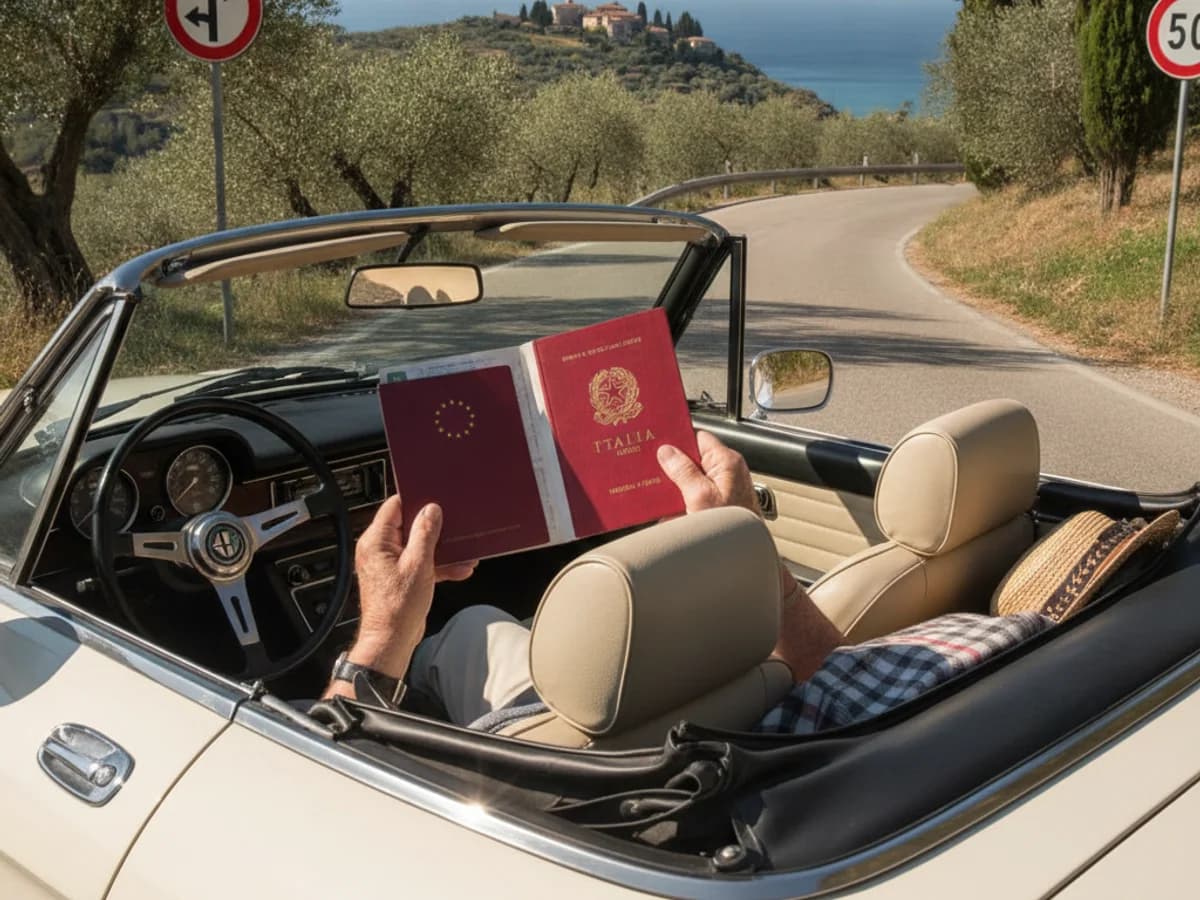

Getting around Italy independently makes retirement life dramatically more enjoyable — especially in rural Tuscany, Umbria, or Sicily where public transport is limited. Understanding how to legally drive in Italy, exchange your license, and navigate local road rules is one of the most practical steps you can take before or shortly after arriving.
⚠️ Important Information
This article is provided for informational purposes only and does not constitute legal, tax, or financial advice. Consult a qualified professional for your personal situation.
Whether you're arriving from the US, UK, Canada, or Australia, the rules differ significantly depending on your nationality and how long you plan to stay. This guide covers everything from license exchange deadlines to Italian traffic laws that catch expats off guard — including the infamous ZTL zones.
📌 Key Takeaways
- EU/EEA driving licenses are valid in Italy without exchange, but non-EU licenses require conversion within 1 year of establishing residency
- Some countries (US, Canada, UK) have bilateral agreements with Italy that simplify the exchange process
- ZTL (Zona a Traffico Limitato) fines regularly target unaware foreign drivers — knowing these zones is essential
- Car insurance in Italy is mandatory and works differently from many other countries
- Medical fitness requirements apply to all drivers over 70, with renewals every 2 years after age 80
Your Foreign License: What's Valid and for How Long
When you first arrive in Italy as a tourist or before establishing residency, your foreign driving license is generally valid for up to 1 year. Once you register as a resident (by obtaining your permesso di soggiorno and registering at the anagrafe), the clock starts ticking.
Non-EU residents have exactly 1 year from the date of establishing legal residency to either exchange their foreign license for an Italian one or obtain a new Italian license from scratch.
EU and EEA citizens face no exchange requirement — their licenses remain valid and are simply renewed under their home country's system. However, if you plan to spend most of your time in Italy, it makes practical sense to eventually obtain an Italian license to simplify administrative matters.
Which Countries Have Exchange Agreements with Italy
Italy has signed bilateral driving license exchange agreements with a limited number of non-EU countries. If your country is on the list, you can exchange your license without retaking the driving test — only a medical examination and paperwork are required.
| Country | Exchange Agreement | Test Required? | Notes |
|---|---|---|---|
| United Kingdom | Yes (post-Brexit agreement) | No | Exchange must occur within 1 year of residency |
| United States | Partial (some states) | Theory test required | Check if your state is listed by MIT Italy |
| Canada | No full agreement | Yes (theory + practical) | Some provinces negotiating bilateral deals |
| Australia | No | Yes (both tests) | Full Italian license process applies |
| Switzerland | Yes | No | EU-equivalent treatment |
| Japan | Yes | No | Direct exchange at *Motorizzazione Civile* |
Always verify the current agreement status directly with the Italian Motorizzazione Civile (MIT), as bilateral agreements can change. The official source is the Italian Ministry of Infrastructure and Transport (MIT) website.
How to Exchange Your License: Step-by-Step
The exchange process in Italy is handled by the Motorizzazione Civile (the Italian equivalent of the DMV). Here is the standard procedure for eligible non-EU nationals:
Step 1 — Gather your documents. You'll need your valid foreign driving license, a certified Italian translation, your codice fiscale, proof of legal residency, passport-size photos, and a medical certificate from an authorized Italian physician (medico monocratico).
Step 2 — Book a medical appointment. The medical exam checks your vision, general fitness, and any conditions that might affect driving ability. It's straightforward for most healthy retirees.
Step 3 — Submit your application. Visit your local Motorizzazione Civile office or go through an authorized autoscuola (driving school), which can handle the paperwork on your behalf for a fee typically between €150 and €300.
Step 4 — Surrender your foreign license. Italy will hold your original foreign license during the exchange process. You receive a temporary Italian license in the meantime.
Step 5 — Receive your Italian license. Processing takes between 4 and 8 weeks on average.
💡 Good to know
Using a local autoscuola to manage your license exchange paperwork saves significant time and frustration. They know the local Motorizzazione Civile staff, understand the current requirements, and can flag missing documents before submission. Expect to pay €200–€350 for this service — money well spent.
Age-Related Medical Requirements for Italian Drivers
Italy has specific medical renewal requirements that apply to older drivers, and retirees need to be aware of these before getting behind the wheel.
Under Italian law (Codice della Strada), standard category B driving licenses are valid for 10 years up to age 50, then for 5 years between 50 and 70. Once you turn 70, the license must be renewed every 2 years. After age 80, renewal is required every 2 years and involves a more thorough medical evaluation.
The medical exam (visita medica) is conducted by an authorized physician and covers eyesight, hearing, reaction times, and general physical fitness. It is not an obstacle for most healthy retirees — but it is non-negotiable. Driving with an expired Italian license carries significant fines.
If you have a pre-existing condition such as diabetes, cardiovascular disease, or epilepsy, additional specialist assessments may be required. Discuss this proactively with your Italian doctor when you establish care with the Italian Healthcare System (SSN).
Understanding ZTL Zones and Italian Traffic Law
Nothing surprises foreign drivers in Italy quite like ZTL fines arriving weeks after a visit. ZTL (Zona a Traffico Limitato) areas restrict vehicle access in historic city centers during specific hours. Cameras photograph license plates automatically — and foreign-registered vehicles are no exception.
Common ZTL rules to know:
- Access is usually restricted from 7:00 AM to 8:00 PM (varies by city)
- Some cities restrict access at all hours in certain zones
- Electric vehicles may be exempt in some cities
- Residents can apply for a ZTL permit (passo carrabile)
If you rent a car or drive your own vehicle into a ZTL zone without authorization, fines typically range from €80 to €500 per infraction. Rental car companies often add an administrative surcharge on top of the fine itself.
Always check the ZTL map of any Italian city you plan to drive into. Apps like ZTL Italia or Google Maps (which now shows some ZTL warnings) can help — but cross-reference with the city's official municipal website for accuracy.
⚠️ Warning
Do not assume GPS navigation will warn you about all ZTL zones — many systems are outdated or incomplete. Always check ZTL restrictions in advance when visiting historic Italian city centers, even for a brief stop.
Car Insurance in Italy: What Retirees Need to Know
Third-party liability insurance (Responsabilità Civile Auto or RC Auto) is mandatory for all vehicles registered in Italy. Without it, you cannot legally drive or park on public roads.
Italian car insurance works on a bonus-malus (no-claims discount) system. Your premium decreases each year without a claim and increases after an at-fault accident. New Italian residents typically start at a disadvantage because they have no Italian driving history — even if they have decades of clean driving abroad.
Some insurers now accept foreign driving records as proof of no-claims history. Bring documentation of your claims history from your home country insurer to negotiate a better starting category.
Comprehensive coverage (kasko) is optional but strongly recommended for newer vehicles. Annual premiums for standard coverage in Italy typically range from €400 to €900 depending on the region, vehicle, and driver profile. Rates in southern Italy and major cities are generally higher.
For retirees purchasing property in Italy, understanding vehicle costs fits naturally into your broader financial planning — as discussed in detail in our guide to the cost of living in Italy for retirees.
Frequently Asked Questions
Can I drive in Italy with my US driving license as a tourist?
Yes. As a tourist (not yet a resident), your US license is valid in Italy for stays up to 1 year, provided you also carry an International Driving Permit (IDP). The IDP acts as an official translation and should be obtained from the AAA before departing the US.
What happens if I miss the 1-year deadline to exchange my license?
Missing the 1-year deadline means you lose the right to exchange — you must then obtain a full Italian license by passing both the theory and practical tests. This is a costly and time-consuming process, so treat the deadline seriously from the day you register as a resident.
Are Italian roads safe for older drivers?
Italian driving can be assertive, particularly in cities. Rural and highway driving is generally straightforward. Statistically, Italy's road fatality rate has improved significantly in recent years and is now close to the EU average. Most retirees adapt well, especially in smaller towns where traffic is lighter.
Do I need a special license to drive a scooter or moped in Italy?
For mopeds up to 50cc, a category AM license is required (or equivalent). For scooters between 50cc and 125cc, you need category A1. Many retirees in coastal towns use scooters as a primary mode of transport — just be aware that helmet use is mandatory and strictly enforced.
Can I keep my foreign-registered car in Italy after becoming a resident?
No. Once you establish Italian residency, you are legally required to re-register your vehicle in Italy within 1 year. Driving a foreign-plated car as an Italian resident beyond that period is illegal and can result in vehicle seizure and significant fines.
Conclusion
Driving independently in Italy opens up a world of possibilities for retirees — from spontaneous day trips through Tuscan vineyards to practical errands in towns with no bus service. The key is acting on the license exchange process early, understanding age-related renewal requirements, and respecting local rules like ZTL restrictions and mandatory insurance.
Plan your driving setup as part of your broader relocation preparation. The earlier you start, the less stressful the process. For a full checklist of everything you need to handle when moving to Italy, see our complete moving to Italy guide for retirees.
Ready to make your Italian retirement a reality? Explore our full resources and tools at ret-italy.com to plan every step of your move with confidence.