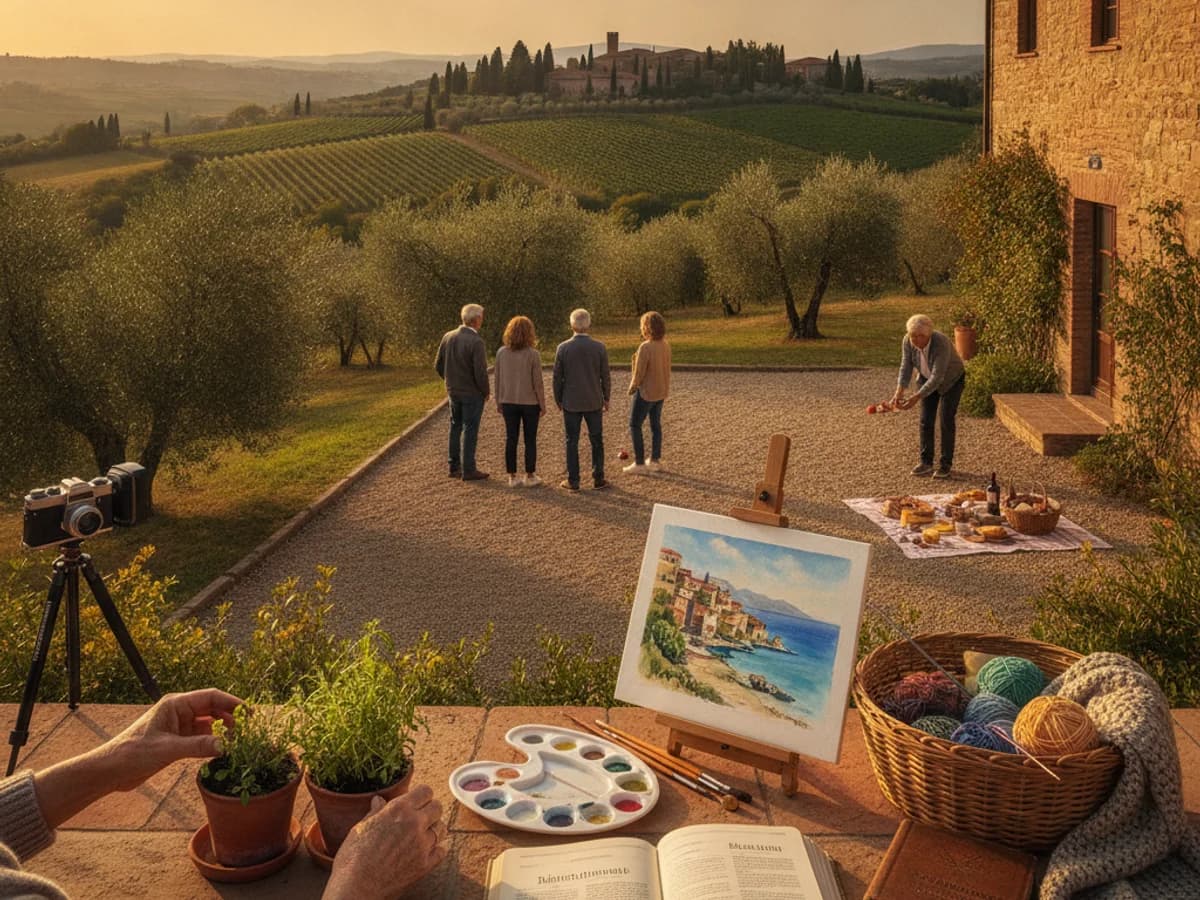

Retiring in Italy gives you something money rarely buys back home: time — and an entire culture built around enjoying it. Whether you want to hike volcanic trails, paint in a hilltop studio, or master fresh pasta from scratch, Italy offers an extraordinary range of activities that keep retirees physically active, mentally sharp, and socially connected.
⚠️ Important Information
This article is provided for informational purposes only and does not constitute legal, tax, or financial advice. Consult a qualified professional for your personal situation.
From organized sports clubs to volunteer programs and cultural associations, the infrastructure for an engaged retirement life is remarkably well developed in Italy — even in smaller towns that rarely appear on tourist maps. This guide covers the best hobbies, activities, and social opportunities available to expat retirees, region by region and interest by interest.
📌 Key Takeaways
- Italy's network of cultural associations (circoli) welcomes foreign members in most mid-size towns
- Many outdoor activities — hiking, cycling, sailing — are free or low-cost year-round
- Volunteer programs offer deep local integration and Italian language practice
- University of the Third Age (Università della Terza Età) runs free or subsidized courses across Italy
Why Staying Active Matters More in Retirement
Research consistently links purposeful daily activity with longer, healthier lives. A 2023 study published by the Italian National Institute of Health (ISS) found that socially engaged retirees showed 34 % lower rates of cognitive decline compared to isolated peers.
Italy's lifestyle naturally encourages movement and community. Daily walks to the market, evening passeggiata along the corso, and shared meals are built into the social fabric. But if you want structure beyond the informal, there is a rich ecosystem of organized activities waiting for you.
Before exploring specific options, make sure your day-to-day setup is sorted. If you are still weighing where to settle, check our guide on the best regions to retire in Italy — your region will directly shape which activities are most accessible.
Outdoor Activities: Italy's Natural Playground
Hiking and Trekking
Italy has over 60,000 km of marked hiking trails managed by the Club Alpino Italiano (CAI). With more than 500 local chapters, CAI organizes weekly group hikes graded by difficulty. Annual membership costs €35–50 and includes third-party liability insurance on club walks.
Popular routes for retirees include the Cinque Terre coastal path (Liguria), the Sentiero degli Dei above Amalfi, and the gentler Monti Euganei hills in Veneto. Most CAI sections offer beginner-friendly Sunday walks suitable for all fitness levels.
Cycling
Italy's EuroVelo network and regional ciclovie (cycle routes) have expanded dramatically since 2020. The VenTo route follows the Po River for 679 km from Turin to Venice — almost entirely flat. Tuscany's Ciclovia dell'Arno connects Florence to the sea through vineyard countryside.
E-bikes (pedelec) are legal on most cycle paths and have transformed cycling accessibility for older riders. Rental e-bikes cost €15–30 per day in most tourist towns.
Golf and Tennis
Italy has approximately 300 golf courses, clustered around Tuscany, Piedmont, and Lake Como. Green fees range from €30 at municipal courses to €120+ at private clubs. Many clubs offer discounted senior memberships starting at €800–1,200 per year.
Tennis clubs (circoli tennis) are found in virtually every Italian town. Annual membership rarely exceeds €300, and many clubs run mixed leagues welcoming foreign players.
Cultural and Creative Pursuits
Cooking Classes and Food Culture
Learning to cook Italian food is not a tourist activity — it is a genuine pathway into Italian social life. Many towns have dedicated scuole di cucina running multi-week courses focused on regional cuisine.
Costs vary: informal home-based courses run €30–60 per session, while professional schools like the Accademia Barilla in Parma charge €150–400 for weekend workshops. Wine appreciation courses (WSET or AIS certification) are available in major cities from €200–600 for full programs.
💡 Good to know
Join your local mercato settimanale (weekly market) community early. Vendors remember regulars, offer better prices, and often become genuine social connections — a simple but powerful integration tool.
Art, Ceramics, and Painting
Italy's artistic heritage makes it an unmatched destination for creative retirees. Regional art schools (accademie di belle arti) often offer community programs open to non-students. Towns like Faenza (ceramics), Deruta (Umbrian pottery), and Volterra (alabaster carving) run artisan workshops year-round.
Painting retreats are a booming niche — week-long residential courses in Tuscany or Umbria typically cost €900–1,800 including accommodation, materials, and instruction.
Music and Choir
Community choirs (cori) are deeply embedded in Italian life, particularly in the north and center. Many welcome non-Italian members and require no audition. Opera appreciation classes run in most provincial capitals, and conservatories occasionally open ensemble rehearsals to the public.
Lifelong Learning: Università della Terza Età
The Università della Terza Età (UTE) is Italy's national network of learning programs specifically designed for older adults. With over 1,000 locations nationwide, UTE offers courses in languages, history, art, technology, gardening, and more.
Annual fees are typically €50–150 for unlimited course access. Classes are taught in Italian, making UTE simultaneously a language-learning environment and a social integration tool. Many expat retirees cite UTE as one of their most important integration experiences.
For tips on building your language skills before joining, see our guide on learning Italian in retirement.
Volunteering and Community Involvement
Voluntary Organizations
Italy has a strong volunteer culture coordinated through the national CSV network (Centri di Servizio per il Volontariato). Options include:
- Hospital visitor programs (assistenza ospedaliera)
- Environmental conservation (WWF Italia, Legambiente)
- Food bank work (Banco Alimentare)
- Cultural heritage restoration (FAI — Fondo per l'Ambiente Italiano)
FAI is particularly popular with expats: volunteers help maintain historic properties and receive guided access to usually closed sites.
⚠️ Warning
Some volunteer roles may require Italian language proficiency and a valid Italian residence permit. Check requirements with individual organizations before committing.
Expat Community Groups
International communities in Italy are well organized in larger cities and coastal retirement hotspots. Groups like Democrats Abroad Italy, the British Institute Florence, and the American International Club of Rome run regular events.
Meetup.com has active expat groups in Milan, Rome, Florence, Bologna, and Naples with weekly social events, language exchanges, and day trips.
Activity Cost Comparison
| Activity | Typical Cost | Frequency | Social Component |
|---|---|---|---|
| CAI Hiking Club | €35–50/year membership | Weekly | High |
| Tennis Club | €200–300/year | Multiple/week | High |
| Golf (municipal) | €30/round or €800+/year | Flexible | Medium |
| UTE Courses | €50–150/year | Weekly | Very High |
| Cooking Classes | €30–60/session | Occasional | Medium |
| Art/Ceramics Workshop | €60–200/session | Occasional | Medium |
| Volunteering (FAI, Banco) | Free | Weekly | Very High |
| Community Choir | Free–€80/year | Weekly | Very High |
Digital and Remote Activities for Rainy Days
Italian winters can be wet and cold in the north and center. Having a portfolio of indoor activities prevents the isolation that sometimes catches retirees off guard during their first winter.
Online platforms like Duolingo, Babbel, and the Italian RAI learning portal support language practice. The Mediaset and RAI streaming services offer Italian television content useful for listening comprehension.
Local biblioteche (public libraries) provide free internet access, book loans, and increasingly host cultural events and film screenings — a free and genuinely local social outlet often overlooked by expats.
Seasonal and Festive Participation
Italy's calendar of sagre (local food festivals), feste patronali (patron saint festivals), and palio (historical pageants) gives retirees a built-in social calendar. Nearly every Italian town holds at least 1 major annual festival.
Volunteering at a local sagra — helping serve food, set up, or guide visitors — is one of the fastest routes into genuine community belonging. Locals notice and appreciate expats who participate rather than merely observe.
Frequently Asked Questions
Can I join Italian sports clubs as a foreign resident?
Yes. EU and non-EU residents with a valid permesso di soggiorno (residence permit) can join almost all Italian sports associations and clubs on the same terms as Italian citizens. Some clubs require CONI (Italian Olympic Committee) affiliation cards, which cost around €10–15 per year.
Is it easy to make Italian friends through hobbies?
It takes longer than making expat friends, but hobbies provide the best environment for genuine Italian friendships. Consistent, repeated contact — weekly hiking, choir rehearsals, market visits — builds the familiarity Italians value. Expect friendships to deepen over 6–18 months rather than weeks.
Are there English-language hobby groups in Italy?
Yes, especially in Florence, Rome, Milan, Bologna, and coastal Liguria. International book clubs, English-language theater groups, and bilingual hiking clubs exist in most cities. Facebook groups and Meetup.com are the most reliable places to find them.
How do I find local clubs and associations in a small town?
Visit the Comune (town hall) and ask for the lista delle associazioni locali — they are legally required to maintain this list. The local Pro Loco (tourism office) also maintains directories. Pinboards outside bars and tabacchi shops carry announcements for local events.
What activities help most with learning Italian?
Activities with high conversational pressure and genuine stakes work best: volunteering, UTE courses taught entirely in Italian, and local sports clubs where you cannot rely on English. Cooking classes taught by monolingual nonne (grandmothers) are notoriously effective and enjoyable.
Conclusion
Italy rewards retirees who engage with it. The country's natural beauty, rich culture, and deeply social lifestyle create extraordinary conditions for an active, meaningful retirement — but access to the best experiences comes from participating rather than observing.
Start with 1 or 2 structured activities that match your fitness level and interests. Build from there. Within a year, most retirees find their Italian social calendar as full as they want it to be.
Ready to take the next step? Explore our complete guide to retiring in Italy for everything you need to plan your move — from visas and taxes to housing and healthcare.