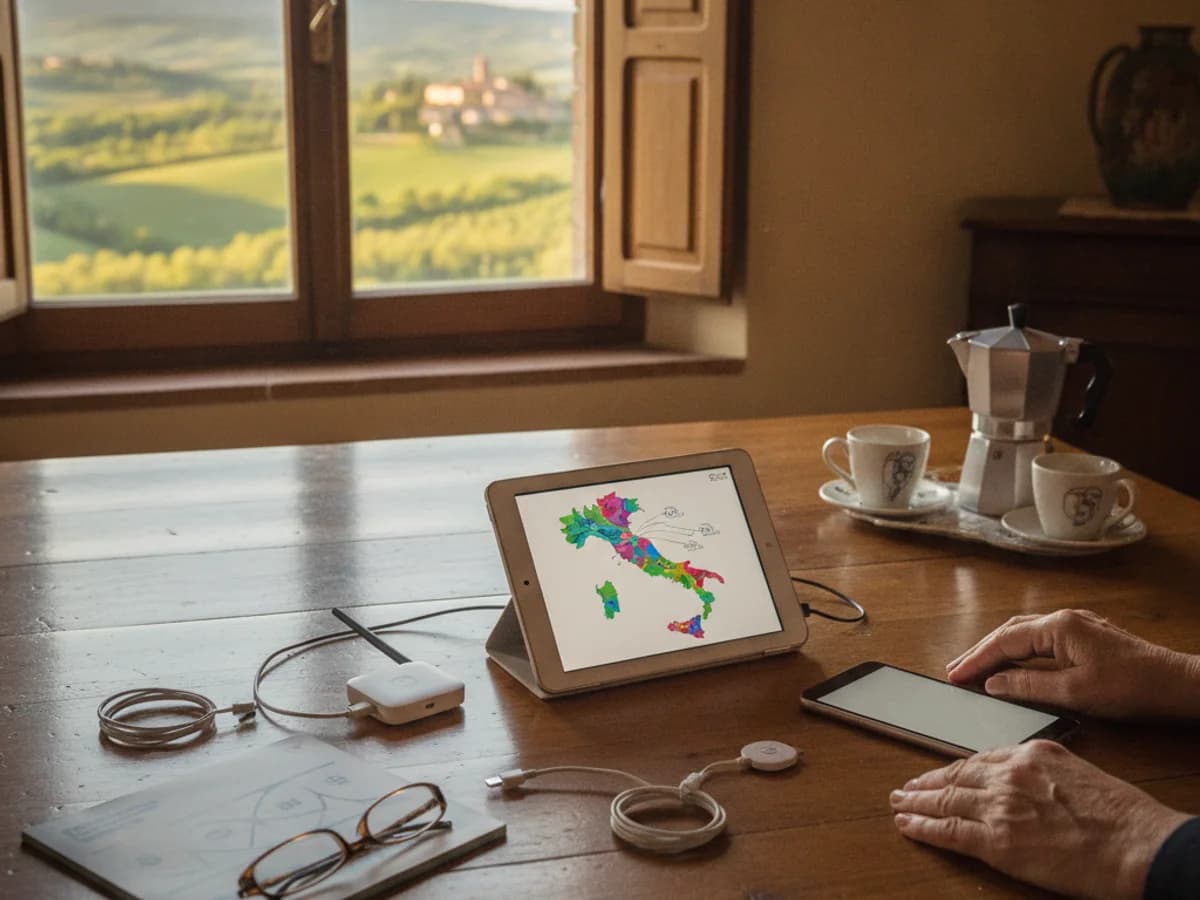

Staying connected in Italy is easier than most retirees expect — and far more affordable than in the UK, US, or Canada. Italy has a competitive telecom market with 4G coverage reaching over 99% of the population, and fiber broadband is expanding rapidly across both cities and rural areas. Whether you need a SIM card on arrival or a full home internet setup, this guide walks you through every step.
⚠️ Important Information
This article is provided for informational purposes only and does not constitute legal, tax, or financial advice. Consult a qualified professional for your personal situation.
📌 Key Takeaways
- Italian mobile plans are among the cheapest in Europe, often €7–15/month for unlimited data
- You need a codice fiscale to sign most contracts — get one before you arrive if possible
- Fiber broadband (FTTH) is available in most Italian cities and many towns as of 2026
- Rural and southern regions may still rely on FTTC or FWA connections — check coverage before signing
- eSIM options now work with most Italian operators, useful for the first weeks after arrival
Why Connectivity Matters More in Retirement
Retiring abroad means your digital connections become your lifeline. Video calls with grandchildren back home, telehealth appointments, streaming services, banking apps, and online communities — all of it depends on a reliable internet connection.
Italy ranked 18th in the EU Digital Economy and Society Index (DESI) in 2024, with significant investment underway to close the gap with northern Europe. For retirees settling in well-connected cities like Florence, Bologna, or Milan, infrastructure is genuinely excellent. For those drawn to a quiet hilltop village in Umbria or Calabria, it pays to research coverage before you sign a lease.
This is closely connected to your overall relocation planning — if you haven't yet reviewed the Italy moving checklist for retirees, it covers connectivity as part of a broader pre-arrival checklist.
Getting Your First SIM Card in Italy
The fastest way to get connected on arrival is a prepaid SIM (SIM prepagata). You can buy one at any airport, train station tabacchi (tobacconist), or operator store.
To activate a SIM you will need:
- A valid passport or EU ID
- Your codice fiscale (Italian tax code)
- A local address (even temporary accommodation works)
If you haven't yet obtained your codice fiscale, read our complete guide to Italian administrative procedures — it explains exactly how to get this essential number before or just after you land.
Best Prepaid Options for New Arrivals
The 4 main operators in Italy are TIM, Vodafone, WindTre, and ILIAD. A fifth player, Fastweb Mobile, has gained strong market share since 2023. Prepaid plans are highly competitive.
| Operator | Monthly Cost | Data Included | Calls & SMS | Best For |
|---|---|---|---|---|
| ILIAD | €9.99 | 150 GB (4G/5G) | Unlimited | Budget-conscious retirees |
| WindTre | €7.99–€12.99 | 100–200 GB | Unlimited | Wide rural coverage |
| TIM | €9.99–€19.99 | 50–100 GB | Unlimited | Best network quality, remote areas |
| Vodafone | €12.99–€19.99 | 100 GB | Unlimited | Expats needing EU roaming |
| Fastweb Mobile | €7.95 | 150 GB | Unlimited | Best value all-round in 2026 |
All of the above plans include EU roaming within the standard data allowance, which matters if you travel frequently back to your home country.
💡 Good to know
ILIAD and Fastweb Mobile are virtual operators but use established network infrastructure. ILIAD uses WindTre's towers; Fastweb uses TIM's. If TIM or WindTre have good coverage in your area, these budget operators will too.
Moving to a Postpaid Contract
Once you have a registered address and an Italian bank account, upgrading to a postpaid (abbonamento) contract is straightforward. Postpaid plans often come with perks such as a free device, higher data caps, and better customer support priority.
Most operators will ask for:
- Codice fiscale
- Proof of residence (certificato di residenza or utility bill)
- Italian IBAN for direct debit
Expect to spend €15–25/month for a premium postpaid plan with 5G access. TIM and Vodafone currently have the widest 5G footprint across Italian cities.
Home Internet: Understanding Your Options
Setting up home broadband involves more steps than a mobile SIM, but costs are very reasonable by international standards. A standard fiber contract runs €25–35/month including the router.
FTTH vs FTTC vs FWA: What You'll Actually Get
- FTTH (Fiber to the Home) — pure fiber directly into your apartment or house. Speeds up to 1 Gbps. Available in most Italian cities and towns with more than 5,000 inhabitants.
- FTTC (Fiber to the Cabinet) — fiber runs to a street cabinet, then copper to your door. Speeds typically 50–200 Mbps. Common in smaller towns and older buildings.
- FWA (Fixed Wireless Access) — a 4G or 5G signal delivered via a router antenna. Used in rural areas where laying cable is not economical. Speeds vary from 30 to 300 Mbps depending on signal quality.
Before signing any contract, use the MISE (Ministry of Enterprise) national broadband map at bandaultralarga.italia.it to check which technology is available at your specific address.
Which Provider for Home Internet?
The main home internet providers are TIM, Vodafone, WindTre, EOLO (specialised in FWA for rural areas), Sky Wifi, and Fastweb. Fastweb and Sky Wifi have built a strong reputation for reliability and customer service among expats.
Installation typically takes 2–4 weeks after signing. In some rural areas, you may wait 6–8 weeks if infrastructure work is needed.
⚠️ Warning
Most Italian broadband contracts have a minimum duration of 24 months. Cancelling early triggers a penalty (penale di recesso) that can reach €150–200. Read the termination clauses carefully before you sign, especially if you are still uncertain about your long-term location in Italy.
Practical Tips for Retirees Moving to Rural Italy
Rural Italy is where many retirees fall in love with the country — and where connectivity requires the most advance planning. A few practical points:
- Check EOLO coverage first if you are in Umbria, Molise, Abruzzo, or inland Sicily — they specialise in rural fixed wireless
- A 5G FWA router from WindTre or TIM can deliver surprisingly fast speeds if there is a tower within 5 km
- Some municipalities in depopulated areas offer subsidised connectivity as part of repopulation initiatives
- Satellite internet (Starlink) is available across Italy. At roughly €40/month plus a one-off hardware cost of €349, it is a genuine option if no landline technology reaches your property
Understanding your daily life setup is closely tied to your choice of region. The best regions to retire in Italy guide includes connectivity notes for each area, which can help you compare options before committing to a location.
Streaming and VPNs: What Retirees Actually Ask About
Two questions come up constantly among expat retirees:
Can I keep my Netflix, BBC iPlayer, or US streaming accounts? Netflix works globally with your existing account. BBC iPlayer and many national public broadcasters are geo-restricted. A VPN service (NordVPN, ExpressVPN, Mullvad) lets you connect through a server in your home country. VPN use for personal streaming is legal in Italy as of 2026.
Will my smart TV work? Yes. Italian electricity is 230V/50Hz with type F (Schuko) sockets. Smart TVs from the UK or US work fine with a plug adapter. No voltage conversion needed for modern electronics.
Frequently Asked Questions
Do I need a codice fiscale to buy a SIM card in Italy?
Yes, all Italian operators require a codice fiscale for any SIM activation, including prepaid. Tourists are sometimes sold SIMs without one, but as a new resident you will need it. You can get your codice fiscale at any Italian consulate before you leave your home country — it is free and takes 24–48 hours.
Can I use an eSIM on arrival in Italy?
Yes. TIM, Vodafone, Fastweb, and ILIAD all support eSIM as of 2026. You can activate an eSIM remotely using your passport details and codice fiscale. This is ideal for the first days after arrival before you have a registered address.
Is 5G available outside major cities in Italy?
5G in Italy is currently concentrated in major cities (Rome, Milan, Naples, Turin, Bologna) and along main transport corridors. As of 2026, TIM and Vodafone are expanding 5G coverage to medium-sized towns. For rural areas, 4G remains the standard for mobile, and FWA may use 5G frequencies for fixed connections.
How long does it take to get home internet set up in Italy?
Allow 2–4 weeks in urban areas and up to 8 weeks in rural zones. Schedule your broadband installation as soon as you have a confirmed address. In the meantime, a mobile hotspot from a prepaid SIM works well as a temporary solution.
What if I have connectivity problems and don't speak Italian fluently?
TIM, Vodafone, and Fastweb all offer English-language customer support lines. ILIAD handles most support via its app, which is available in English. For technical issues, third-party English-speaking expat services and local assistenza tecnica shops (computer repair stores) are found in most towns with an expat population.
Conclusion
Getting connected in Italy is affordable, reliable in most areas, and straightforward once you have your codice fiscale in hand. The key decisions — mobile operator, home internet technology, and whether you need a VPN — all depend on where exactly you are settling and how you use technology day to day. Plan your connectivity setup as early as your housing search, not as an afterthought.
Ready to take the next step? Explore the full Ret Italy retirement guide for a complete overview of everything you need to organise before, during, and after your move — from visas and taxes to daily life in your new home.