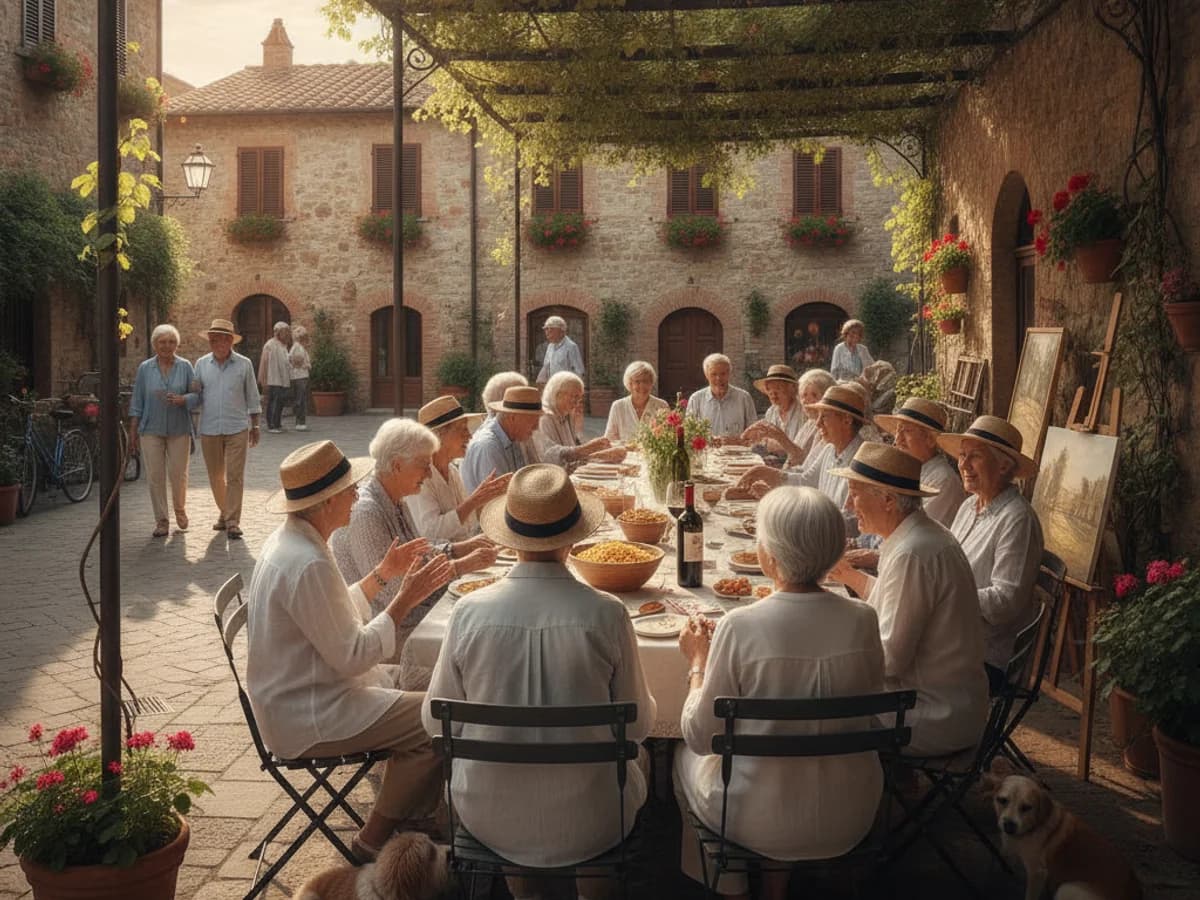

One of the most underestimated challenges of retiring in Italy isn't the paperwork or the taxes — it's building a fulfilling social life from scratch. The good news: Italy is one of the most socially rich countries in the world, and retirees who approach it with the right mindset consistently report deep, lasting connections within their first year.
⚠️ Important Information
This article is provided for informational purposes only and does not constitute legal, tax, or financial advice. Consult a qualified professional for your personal situation.
Whether you're moving from the US, UK, Canada, or Australia, Italy's social fabric is built around community, shared meals, and daily rituals that actively welcome newcomers — if you know where to look. This guide walks you through the most practical strategies for building genuine friendships, joining the right communities, and avoiding the isolation trap that catches too many expat retirees off guard.
📌 Key Takeaways
- Italy's social culture revolves around regular routines — adopting them is your fastest integration tool
- Expat clubs and international associations exist in virtually every region popular with retirees
- Learning even basic Italian dramatically accelerates social integration with locals
- Volunteering and hobby groups are among the most effective ways to meet both expats and Italians
- Loneliness is the #1 underreported issue for retirees abroad — having a social plan before you move is essential
Why Social Integration Matters More Than You Think
Retirement research consistently shows that social connection is one of the strongest predictors of health and happiness in later life. A 2023 study by the OECD ranked Italy among the top 5 countries in Europe for community belonging — yet expat retirees frequently report feeling on the outside looking in during their first 6 to 12 months.
The reason is structural. Italian social life is deeply rooted in longstanding local networks — the same bar, the same piazza, the same Sunday lunch rotation — built over decades. Breaking into these circles requires patience, consistency, and a willingness to show up repeatedly before bonds truly form.
The retirees who thrive socially in Italy share one common trait: they don't wait for the community to come to them. They build a deliberate social calendar from day one.
Understanding Italian Social Culture
Before you can build connections, you need to understand how Italians actually socialize. It's fundamentally different from Anglo-American patterns, and misreading the signals leads to unnecessary frustration.
Italian friendships tend to deepen slowly but last a lifetime. An invitation to someone's home is a significant gesture — far more meaningful than in countries where casual dinner parties are commonplace. In contrast, daily interactions at the bar, the market, and the piazza are warm, frequent, and deeply important. These are not superficial exchanges; they are the texture of Italian community life.
The aperitivo hour (typically 6pm to 8pm) functions as a social institution. Positioning yourself as a regular at a local bar during this window — consistently, over weeks — is one of the fastest ways to shift from being a stranger to being a known face.
💡 Good to know
In southern Italy and Sicily — regions with the lowest cost of living — communities tend to be tighter-knit and initially more formal with newcomers. In Tuscany and Umbria, the higher concentration of expats means international social networks are already well-established and easier to tap into quickly.
Expat Clubs and International Organizations
The most immediate social resource for any newly arrived retiree is the existing expat community. These networks are well-organized in most regions that attract foreign retirees.
Key organizations to know:
- Democrats Abroad Italy — active chapters in Rome, Milan, Florence, and Naples
- The American Women's Association of Rome — one of Italy's oldest expat social organizations, open to all
- British Italian Society — cultural and social events across major cities
- Internations — the largest global expat platform, with active groups in 12+ Italian cities
- Facebook Groups — search "expats in [your city/region]" for hyperlocal communities
Most of these groups organize regular events: cooking classes, day trips, wine tastings, museum visits, and holiday dinners. They are excellent entry points, but experienced expats caution against relying on them exclusively. The risk is creating a bubble of fellow foreigners rather than genuinely integrating into Italian life.
For deeper context on choosing the right region for your social environment, see our guide on best regions to retire in Italy.
Learning Italian: Your Most Valuable Social Investment
No single factor does more for your social life in Italy than learning Italian — even at a basic level. Italians respond with warmth and enthusiasm to foreigners who make the effort, even imperfectly.
You do not need fluency to connect. A B1 level (conversational intermediate) is sufficient for most daily social interactions. The key is consistent practice, not perfection.
Practical ways to learn Italian as a retiree in Italy:
- In-person group classes at local schools (scuole di lingua) — these are social events as much as lessons
- Tandem language exchange — pair with an Italian who wants to practice English
- University of the Third Age (Università della Terza Età) — low-cost courses designed for older adults, deeply embedded in local communities
- One-on-one tutoring via platforms like iTalki or Preply
The Università della Terza Età (UTE or U3A) deserves special mention. These institutions exist in almost every Italian town of any size and offer courses in languages, art history, music, cooking, and more. The student body is almost entirely Italian retirees — making them one of the rare genuine gateways into local social networks.
Activities That Build Genuine Community
Beyond language learning, certain activities are particularly effective at generating the kind of repeated contact that turns acquaintances into friends.
| Activity | Social Mix | Language Required | Ease of Entry |
|---|---|---|---|
| Università della Terza Età | Mostly Italian locals | Italian helpful | Easy — open enrollment |
| Expat club events | Mostly expats | English fine | Very easy |
| Local hiking / walking groups | Mixed | Basic Italian useful | Easy — search CAI (Club Alpino Italiano) |
| Volunteer organizations | Mostly Italian locals | Italian helpful | Moderate |
| Church / faith communities | Mostly Italian locals | Italian or Latin | Easy — universally welcoming |
| Cooking / wine classes | Mixed expats and tourists | None required | Very easy |
| Bocce / pétanque clubs | Mostly older Italian men | Basic Italian useful | Easy — just show up |
Volunteering deserves particular emphasis. Organizations like the Misericordia (community assistance), Caritas, and local cultural associations (the pro loco) are present in virtually every Italian municipality. They are deeply embedded in local identity and warmly welcome motivated foreign volunteers. The relationships you build through shared service tend to be among the most authentic.
Digital Communities and Online Support Networks
Before you move — and during your first months — online communities provide invaluable support and a sense of belonging that helps offset the inevitable adjustment period.
The most active communities include:
- Retire in Italy (Facebook) — 25,000+ members, highly active
- Americans in Italy (Facebook) — strong practical support culture
- Reddit r/ItalyExpatNetwork — unfiltered honest advice
- Internations Italy forums — more professionally oriented
These spaces are also where you'll find recommendations for English-speaking doctors, trusted local accountants, and regional meet-up events — all practical anchors for your social life during the transition.
For a broader look at the cultural adjustments involved in moving to Italy, our cultural adaptation guide for retirees covers the psychological and practical dimensions in depth.
⚠️ Warning
Relying entirely on online communities or expat-only circles can delay genuine integration and increase the risk of isolation if those networks shift. Aim to build at least some connections with Italian locals within your first 6 months.
Building a Social Routine: A Practical First-Year Framework
The retirees who integrate most successfully tend to follow a similar pattern in their first 12 months. Here is a framework drawn from their experiences:
Months 1-3 — Establish anchors:
- Choose 1 or 2 local bars and become a regular
- Join 1 expat organization for immediate English-language contact
- Enroll in Italian language classes
Months 4-6 — Expand deliberately:
- Join 1 activity-based group (hiking, cooking, art, sport)
- Attend at least 1 Università della Terza Età course
- Identify 1 volunteer opportunity
Months 7-12 — Deepen and consolidate:
- Accept every reasonable social invitation
- Host your own gathering (even a simple aperitivo at home)
- Maintain your bar routine — consistency is everything
This framework is not rigid, but it reflects a key insight: social capital in Italy is built through repetition and presence, not grand gestures.
Frequently Asked Questions
Is it hard to make Italian friends as a retiree?
It takes longer than making expat friends, but it is absolutely achievable. Italians are warm and curious about foreigners who make genuine effort. The key is consistency — showing up at the same places regularly — and at least basic Italian. Most retirees report their first genuine Italian friendships forming between 6 and 18 months after arrival.
Do I need to speak Italian fluently to have a good social life?
No. Many retirees live very happily in Italy with intermediate Italian and an active expat social network. However, learning Italian — even to a conversational level — significantly enriches your experience and opens doors to local friendships that English alone cannot. It is the single highest-return investment you can make before and after moving.
Which Italian regions are best for expat social life?
Tuscany (especially the Chianti and Lucca areas), Umbria, and the Amalfi Coast have the most developed expat communities. Sicily and Puglia have smaller but growing expat networks and are gaining popularity rapidly. Larger cities like Rome, Milan, and Florence have extensive international communities but can feel less intimate than smaller towns.
Are there English-speaking social clubs outside major cities?
Yes, more than most people expect. Many smaller towns in Tuscany, Umbria, Le Marche, and Sicily have active English-speaking social groups, often organized informally through Facebook or Meetup. Internations also has chapters in smaller regional hubs. Doing a targeted online search for your specific town or province before you move is strongly recommended.
How do I avoid loneliness during my first months in Italy?
Having a concrete social plan before you arrive is the most effective prevention. Identify 2 or 3 organizations or classes to join in advance, commit to a daily routine that gets you out of the house, and stay connected with your home country network while actively building your Italian one. Loneliness in the first 3 to 6 months is normal — it does not mean you made the wrong decision.
Conclusion
Building a rich social life in Italy as a retiree is entirely achievable — but it requires intention, patience, and a willingness to adapt to Italian rhythms rather than expecting them to adapt to you. The retirees who thrive are those who show up consistently, invest in the language, and balance their expat connections with genuine engagement in local life.
Italy rewards persistence with extraordinary depth. The friendships, the shared meals, the sense of belonging to a place with centuries of human texture — these are among the greatest gifts retirement in Italy can offer.
Ready to take the next step? Explore our complete guide to retiring in Italy in 2026 for everything you need to plan your move with confidence.